

Nothing sets the festive mood better than the ceremony of opening a quality bottle of traditional method wine and making a toast, whether it’s an intimate dinner or larger celebration.
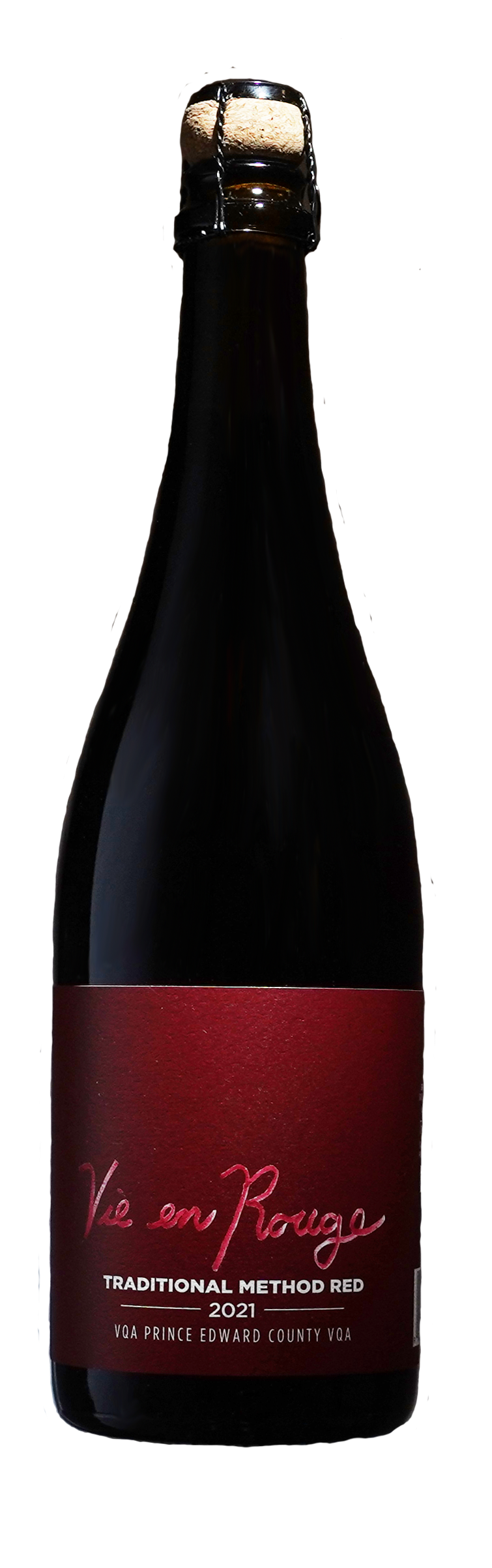
Announcing the 2021 Vintage release of Amour, our classic Pinot Noir-Chardonnay traditional method sparkling, and the unique Vie en Rouge, a red traditional method sparkling made from Gamay and Pinot Noir. VQA Prince Edward County, 3 years sur lie.
Read the story of their making, below. You can also check out a cool video of the disgorging process on our Instagram feed. You can buy the wines online or visit our store at the winery.

You need patience to make Traditional Method
The vision for Amour began fourteen years ago when I planted our first vines in 2010 and selected the varietals Chardonnay, Pinot Noir and Pinot Meunier. At the time it seemed like a far off flight of fancy that we could ever make a traditional method sparkling wine. I had only the faintest idea of how to go about it.
It wasn’t until a harvest eight years later that I set aside a tonne of Chardonnay, Pinot Noir and Pinot Meunier for an experimental batch of traditional method wine, conducting the tirage, riddling, and disgorging of 500 bottles painstakingly by hand. We blended and fermented a base cuvée, and then we bottled it under a crown cap with a little extra sugar, nutrients, and riddling agents for the second fermentation. The bottles rested on their sides in a cage for three years “sur lie”, to let the yeast autolyse. During this time, the coveted traditional method flavours are imparted into the wine.
After three years, we put the bottles outside to chill them, and then disgorged them “a la volée” by hand, then applied a cork and muselet. We washed the bottles, dried them, and applied a label and foil.
That first year we put some of the corks in a little too deep. They were impossible to remove by hand. The first fifty or so people that received the bottles were forced to be creative in opening the bottles. Many sabering videos were circulated!
We were very pleased with the 2018 Vintage of Amour. Although it was made using the traditional method, it was never sent into VQA. VQA has some very specific guidelines around sparkling wine and it costs over $300 per wine to go through the approval process. For an experimental batch it just isn’t worth it. We called the wine “Artisanal Sparkling” instead of “Traditional Method”, because Traditional Method is a legally protected term. In retrospect, we probably shouldn’t have used the term “Sparkling” without the wine being VQA Approved either.
Bolstered by the success of our experimental batch, we went a little bigger in 2021, and made 2,300 more bottles of Amour. We also had quite a bit extra cuvée left over from making our sparkling red wine Power Take Off, which is done using the charmat method. With a dash of bravado, we decided to answer the question “how would a traditional method version of the red sparkling work out?” and we put 1,500 litres of the PTO cuvée into sparkling bottles, where it would transform into Vie en Rouge.
These tirage sessions happened against a background of considerable stress; it was in the middle of the COVID pandemic and because of supply chain issues, at one point I had 10,000 sparkling bottles on the crush pad.
In retrospect, committing to more than 4,000 bottles of traditional method sparkling wine was quite a bold move.
Traditional method wine was something we had only done at an experimental level. We didn’t have a game plan of how we were going to disgorge all those bottles — it just wouldn’t be practical to do it by hand like we had for the initial test batch. We just knew that when the time came we would figure out a way. We also didn’t have a marketing plan beyond the tasting room and our wine club to sell the wine. Build it and they will come!
The idea was that our traditional method program would create a three-year-sur-lie sparkling wine. We wanted to build a rolling production of three vintages while we waited for the ageing sur lie process to complete, so we could release a new vintage each year. Consequently, we committed 2,000 bottles more in both 2022 and 2023.
By the start of 2024 we had seventeen cages of sparkling wine ageing in a warehouse in Picton. Each cage holds 500 bottles. The inventory was tying up quite a bit of working capital. We were behind schedule in disgorging the 2021 wine, and I didn’t want to buy more cages or invest in more storage. This was getting a little crazy, so I said to myself – “no more traditional method sparkling wine goes into bottle until we start selling what we’ve got”.
I was still a little foggy on how the heck I was going to disgorge the 2021 Vintage. There were a few options, but they ranged a spectrum from very tedious to very expensive. I was getting nervous, having so much inventory tieing up my capital. I heard of other wineries releasing 10-year sur lie sparkling wines. It sounds impressive but longer sur lie isn’t necessarily better. Noi one would ever admit it, but I suspect sometimes it may not be on purpose. It’s because they can’t figure out how to get it disgorged and packaged. It just sits there for years, waiting for a solution. I didn’t want to fall into a situation like that. I had to get my bottles disgorged.
Finally at the end of 2024 Viniserve, a mobile bottling service, reached out to me. “We have some space in our schedule, we can just fit you in”, said Lucie, our contact there. “But the riddling has to go perfectly.”
I sent Viniserve some sample bottles in for a trial disgorging run. A week later they reported that the Amour test disgorging went perfectly, but the red wine was problematic. “It’s very nervous,” Lucie said. “We may not be able to disgorge it.”
That made ME very nervous. What would I do? “Send another sample in, we’ll chill it to a lower temperature and try another test.”
Another week passed before Lucie called back.
“I wanted to talk to you about the red sparkling test,” she said flatly.
“Gulp,” I thought.
“We chilled the wine and it disgorged perfectly!”
“Phew!” I let out my breath.
Viniserve offers what they call a complete disgorging service. There are three main steps. In the first, they rent a large hydraulic machine to you with riddling cages. You load up each riddling cage with 504 bottles on their side, forklift the cages into the machine, close the gate, and the machine runs a program to jiggle the bottles for a week, carefully coaxing all the sediment into the neck of the bottles. At the end of the process the bottles are upside down “sur point” and all the sediment is in the neck of the bottle.
The machine can riddle two cages at a time. It takes a week to complete one cycle. We had nine cages so the machine was running for five weeks.
In the next step, Viniserve brings a large enclosed trailer that has a disgorging line built into it. We carefully unload the bottles from the cages and place them upside down into a glycol bath, which freezes the neck. From there, an automatic line pops off the crown cap, the sediment sprays out, the dosage is added and the wine is topped up, a cork is applied, then the muselet, and the bottles are carefully tipped up and down a few times to mix up the liquid.
We then put the bottles back into cages to rest and warm up overnight. They are too cold to move to the labelling step immediately — the bottles are sweating and the glue on the labels doesn’t stick as well when it’s cold.
After the disgorging, a driver comes from Viniserve to swap out the disgorging trailer for the washing/labelling line. Here we handle the bottles once more time, loading them out of the storage cages onto another assembly line, where they get washed, dried, labelled, hooded, and finally carefully placed in a box, labels up.
The riddling/disgorging process requires many inputs to come together all at once — not only does the wine have to be good, but the corks, labels and foils must be ordered and arrive on time, the sediment in the bottles needs be easily to riddled over the course of five weeks, the labels have to be completed before bottling with all the exacting terminology, alc./vol. and font sizes, VQA has to approve the chemistry of the wine, I have to prepare 40 litres of a sugar/ascorbic acid/KMS solution for dosage, the pressure in the bottle has to be high enough, we need to hook up 3 phase power to run the equipment, a reefer trailer needs to be rented so the bottles are at zero degrees before disgorging, and we need to find three people to help us on each day.
We ran into a minor snag when we received the foils for the Vie en Rouge and they were the wrong shade of burgundy. It was Tuesday and we would be applying foils on Thursday. We thought about applying the foils and reprinting the labels, and we thought about driving four hours to Syracuse New York overnight to get a different colour of foil, but after much hand wringing we decided simply not to apply foils at all, apply the existing labels, and to send the wrong colour foils back.
In the end everything else came together for the disgorging process and we finished packing the last box by Friday afternoon. All that remained after bottling was to submit two bottles of each wine for the VQA approvals. Anxious to get approvals completed so I could begin to sell the wine, on Monday morning I drove the bottles to Toronto myself and dropped them off at the VQA offices in North York. I also dropped a couple of bottles off at WineAlign in Etobicoke for tasting and reviews, in the hopes of squeezing our wines into their Fizz Guide that was being released the next day (missed the deadline, dang).
It used to be if you dropped bottles off for VQA testing on Monday morning you could expect a result by Friday. The last couple of wines we’ve sent in have taken two weeks. So we waited on tenterhooks for thirteen days, worrying that there would be some problem that would prohibit us from using the coveted “Traditional Method” and “VQA Prince Edward County ” terms on our labels. Since everything was already labelled, if our labels failed VQA we would incur some great costs. We would have to either print little stickers to cover the disallowed terms, or we would have to print new labels and carefully cover up the old ones.
I know they do the lab testing on Wednesdays, and the first Thursday passed by with no lab report, so by the second Thursday I was fit to be tied. I sat at my computer doing paperwork on one screen and neurotically refreshing the VQA Member portal on another screen, to see if my approvals had come through. In the early afternoon, tiny green checkmarks appeared beside Amour and Vie en Rouge, indicating the approvals had been granted.
Phew! They passed.
Finally we can release the wines! Let the marketing begin.
| disgorging | in traditional method wine production, the process of uncapping the wine to remove the sediment from the second fermentation |
| ageing sur lie | when wine is exposed to the expired yeast for a period of time, often years. Can provide the classic biscuity aged sparkling flavour, finer bubbles, better mouthfeel and a sense of sweetness |
| riddling | manipulating a sparkling bottle so that the sediment ends up in the neck of the bottle, in preparation for disgorging |
| muselet | the wire cap that holds the cork on a sparkling wine bottle |
| a la volée | “on the fly” manual disgorging |
| autolysis | the process of yeast cell walls breaking down and proteins dissolving back into solution |
| sur point | bottles stored upside down |
| tirage | mixing more yeast ,sugar and adjuvants with the base wine and putting it into a vessel to begin the secondary fermentation |
| traditional method | the bubbles come from secondary fermentation of yeast conducted under pressure in the bottle under a crown cap. Makes complex, finer wines. |
| charmat method | the bubbles come from secondary fermentation by yeast conducted in a bulk tank, then bottled under pressure. Makes fruity, quick-to-market wines. |
| cuvée | the blend of the base wine used in sparkling |
| liqueur d’expedition | a blend of wine, sugar, sulphites and other additives that is added to the bottle during disgorging to sweeten/preserve/ or adjust the wine |
| dosage | the addition of sugar at disgorging |
 brokenstone.ca
0 comments on “Classy Bubbles just in time for the Holidays”